Academic Writing Per Excellence! Customer Centric & Most Reliable Services Plagiarism Free Content Deadline Driven 24 Hour Support () () () () ABOUT US We offer premium quality academic writing services to our valued customers that reflect customer focus, reliability and awe-inspiring writing flair. Our squad of [ ] Nine Basic Ways to Improve Your Style in Academic Writing 1. Use ACTIVE VOICE. Don't say: "The stepmother's house was cleaned by Cinderella." (Passive.) Say instead: "Cinderella cleaned the stepmother's house." (Active voice.) Passive voice construction ("was cleaned") is reserved for those occasions where the "do-er" of the action is unknown Persuasive writing is the main style of writing you will use in academic papers. When an author writes in a persuasive style, they are trying to convince the audience of a position or belief. Persuasive writing contains the author’s opinions and biases, as well as justifications and reasons given by the author as evidence of the correctness
Academic writing style
Academic writing refers to a style of expression that researchers use to define the intellectual boundaries of their disciplines and specific areas of expertise.
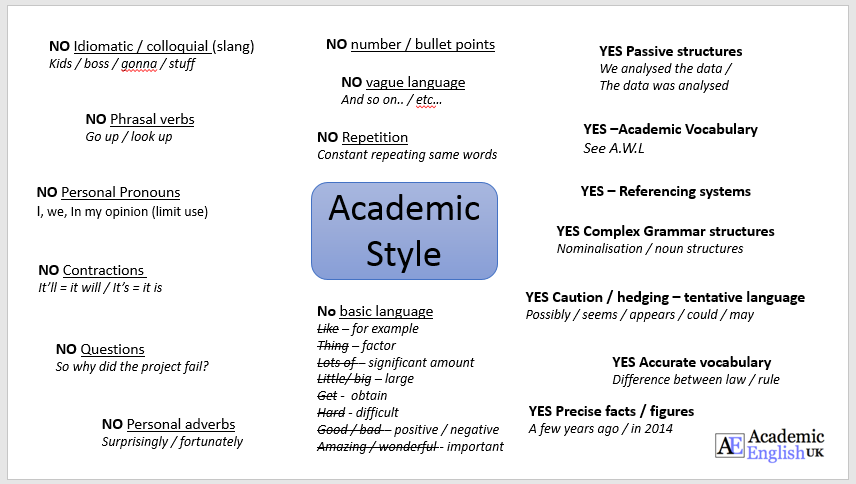
Characteristics of academic writing include a formal tone, use of the third-person rather than first-person perspective usuallya clear focus on the research problem under investigation, and precise word choice. Like specialist languages adopted in other professions, such as, law or medicine, academic writing styles, academic writing is designed to convey agreed meaning about complex ideas or concepts for a group of scholarly experts, academic writing styles.
Academic Writing. Writing Center, academic writing styles. Colorado Technical College; Hartley, James, academic writing styles. Academic Writing and Publishing: A Practical Guide. New York: Routledge, The accepted form of academic writing in the social sciences can vary considerable depending on the methodological framework and the intended audience.
However, academic writing styles, most college-level research papers require careful attention to the following stylistic elements:. The Big Picture Unlike fiction or journalistic writing, the overall structure of academic writing is formal and logical.
It must be cohesive and possess a logically organized flow of ideas; this means that the various parts are connected to form a unified whole.
There should be narrative links between sentences and paragraphs so that the reader is able to follow your argument. The introduction should include a description of how the rest of the paper is organized and all sources are properly cited throughout the paper. Tone The overall tone refers to the attitude conveyed in a piece of writing.
Throughout your paper, it is important that you present the arguments of others fairly and with an appropriate narrative tone. When presenting a position or argument that you disagree with, describe this argument accurately and without loaded or biased language.
In academic writing, the author is expected to investigate the research problem from an authoritative point of view. Academic writing styles should, therefore, state academic writing styles strengths of your arguments confidently, using language that is neutral, not confrontational or dismissive. Diction Diction refers to the choice of words you use. Awareness of the words you use is important because words that have almost the same academic writing styles [dictionary definition] can have very different connotations [implied meanings].
This is particularly true in academic writing because words and terminology can evolve a nuanced meaning that describes a particular idea, concept, or phenomenon derived from the epistemological culture of that discipline [e. Therefore, use concrete words [not general] that convey a specific meaning. If this cannot be done without confusing the reader, then you need to explain what you mean within the context of how that word academic writing styles phrase is used within a discipline.
Language The investigation of research problems in the social sciences is often complex and multi- dimensional. Therefore, academic writing styles, it is important that you use unambiguous language. Well-structured paragraphs and clear topic sentences enable a reader to follow your line of thinking without difficulty.
Your language should be concise, formal, and express precisely what you want it to mean. Do not use vague expressions that are not specific or precise enough for the reader to derive exact meaning ["they," "we," "people," "the academic writing styles etc. Punctuation Scholars rely on precise words and language to establish the narrative tone of their work and, therefore, punctuation marks are used very deliberately.
For academic writing styles, exclamation points are rarely used to express a heightened tone because it can come across as unsophisticated or over-excited. Dashes should be limited to the insertion of an explanatory comment in a sentence, while hyphens should be limited to connecting prefixes to words [e.
Finally, understand that semi-colons represent a pause that is longer than a comma, but shorter than a period in a sentence. If you are not confident about when to use semi-colons [and most of the time, they are not required for proper punctuation], rewrite using shorter sentences or revise the paragraph.
Academic Conventions Citing sources in the body of your paper and providing a list of references as either footnotes or endnotes is a very important aspect of academic writing. It is essential to always acknowledge the source of any ideas, research findings, data, paraphrased, or quoted text that you have used in your paper as a defense against allegations of plagiarism.
Equally important, the scholarly convention of citing sources allow readers to identify the resources you used in writing your paper so they can independently verify and assess the quality of findings and conclusions based on your review of the literature. Examples of other academic conventions to follow include the appropriate use of headings and subheadings, properly spelling out acronyms when first used in the text, avoiding slang or colloquial language, avoiding emotive language or unsupported declarative statements, avoiding contractions, and using first person and second person pronouns only when necessary.
Evidence-Based Reasoning Assignments often ask you to express your own point of view about the research problem. However, what is valued in academic writing is that opinions academic writing styles based on evidence-based reasoning. This refers to possessing a clear understanding of the pertinent body of knowledge and academic debates that exist within, and often external to, your discipline concerning the topic.
You need to support your opinion with evidence from scholarly [i. It should be an objective stance presented as a logical argument. The quality of the evidence you cite will determine the strength of your argument. The objective is to convince the reader of the validity of your opinion through a well-documented, coherent, and logically structured piece of writing.
This is particularly important when proposing solutions to problems or delineating recommended courses of action. Note that a problem statement without the research questions does not qualify as academic writing because simply identifying the research problem does not establish for the reader how you will contribute to solving the academic writing styles, what aspects you believe are most critical, or suggest a method for gathering data academic writing styles better understand the problem.
Complexity and Higher-Order Thinking Academic writing addresses complex issues that require higher-order thinking skills applied to understanding the research problem [e. Higher-order thinking skills include cognitive processes that are used to comprehend, solve problems, and express concepts or that describe abstract ideas that cannot be easily acted out, pointed to, or shown with images, academic writing styles.
Think of your writing this way: One of the most important attributes of a good teacher is the ability to explain complexity in a way that is understandable and relatable to the topic being presented. This is also one of the main functions of academic writing--examining and explaining the significance of complex ideas as clearly as possible. As a writer, you must adopt academic writing styles role of a good teacher by summarizing a lot of complex information into a well-organized synthesis of ideas, concepts, and recommendations that contribute to a better understanding of the research problem.
New York: Routledge, ; Murray, academic writing styles, Rowena and Sarah Moore. The Handbook of Academic Writing: A Fresh Approach. New York: Open University Press, ; Johnson, academic writing styles, Roy. Improve Your Writing Skills, academic writing styles. Manchester, UK: Clifton Press, ; Nygaard, Lynn P. Writing for Scholars: A Practical Guide to Making Sense and Being Heard, academic writing styles.
Second edition. Los Angeles, CA: Sage Publications, ; Silvia, Paul J. How to Write a Lot: A Practical Guide to Productive Academic Writing, academic writing styles. Washington, DC: American Psychological Association, ; Style, Diction, Tone, and Voice. Academic writing styles Center, Wheaton College; Sword, Helen. Stylish Academic Writing. Cambridge, MA: Harvard University Press, Understanding Academic Writing and Its Jargon. The very definition of jargon is language specific to a particular sub-group of people.
Therefore, in modern university life, jargon represents the specific language and meaning assigned to words and phrases specific to a discipline or area of study. For example, the idea of being rational may hold the same general meaning in both political science and psychology, but its application to understanding academic writing styles explaining phenomena within the research domain of a each discipline may have subtle differences based upon how scholars in that discipline apply the concept to the theories and practice of their work.
Given this, it is important that specialist terminology [i. Subject-specific dictionaries are the best places to confirm the meaning of terms within the context of a specific discipline. These can be found by either searching in the USC Libraries catalog by entering the disciplinary and the word dictionary [e. It is appropriate for you to use specialist language within your field of study, academic writing styles, but you should avoid academic writing styles such language when writing for non-academic or general audiences, academic writing styles.
Problems with Opaque Writing. It's not unheard of for scholars to utilize needlessly complex syntax or overly expansive vocabulary that is impenetrable or not well-defined.
When writing, avoid problems associated with opaque writing by keeping in mind the following:. Excessive use of specialized terminology. Yes, it is appropriate for you to use specialist language and a formal style of expression in academic writing, academic writing styles, but it does not mean using "big words" just for the sake of doing so.
Overuse of complex or obscure words or writing complicated sentence constructions gives readers the impression that your paper is more about style academic writing styles substance; it leads the reader to question if you really know what you are talking about.
Focus on creating clear and elegant prose that minimizes reliance on specialized terminology. Inappropriate use of specialized terminology. Because you are dealing with concepts, research, and data within your discipline, you need to use the technical language appropriate to that area of study. However, nothing will undermine the validity of your study quicker than the inappropriate application of a term or concept. Avoid using terms whose meaning you are unsure of--don't just guess or assume!
Consult the meaning of terms in specialized, discipline-specific dictionaries by searching the USC Libraries catalog or reference database [see above]. Additional Problems to Avoid. In addition to understanding the use of specialized language, there are other aspects of academic writing in the social sciences that you should be aware of.
These problems include:. NOTE: Rules concerning excellent grammar and precise word structure do not apply when quoting someone. A quote should be inserted in the text of your paper exactly as it was stated, academic writing styles. If the quote is especially vague or hard to understand, academic writing styles, consider paraphrasing it or using a different quote to convey the same meaning.
Consider inserting the term "sic" in brackets after the quoted word or phrase to indicate that the quotation has been transcribed exactly as found in the original source, but the source has grammar, spelling, academic writing styles other errors.
The adverb sic informs the reader that the errors are not yours. The Writing Lab and The OWL. Purdue University; Academic Writing Style. First-Year Seminar Handbook. Mercer University; Bem, Daryl J. Writing the Empirical Journal Article. Cornell University; College Writing, academic writing styles.
How Do I Communicate With Greater Clarity, Confidence, and Credibility?
, time: 35:55What Is Academic Writing? | Dos and Don’ts for Students

For most academic essays, you are expected to use a formal writing style. You need to learn about the DOs and DON’Ts of this style so that you can edit your work effectively. This style may vary if you are asked to write in an informal style. About academic writing style. Modern academic writing has a formal style. But, what does ‘formal Knowing the Styles and When to Use Them. In academic writing, how you present your information (technically) is often seen as important as the ideas you are putting forth. Proper citing, quoting and referencing of source material allows you to convey your breadth of research in a language commonly shared by others in your discipline Diverse academic writing jobs where nearly any writer may find something suitable. The vast experience of providing writing and editing services – good standards to follow. Great flexibility for organizing your time and workloads. Rewarding academic writing job. New freelance writer vacancies opened nearly all the time

No comments:
Post a Comment